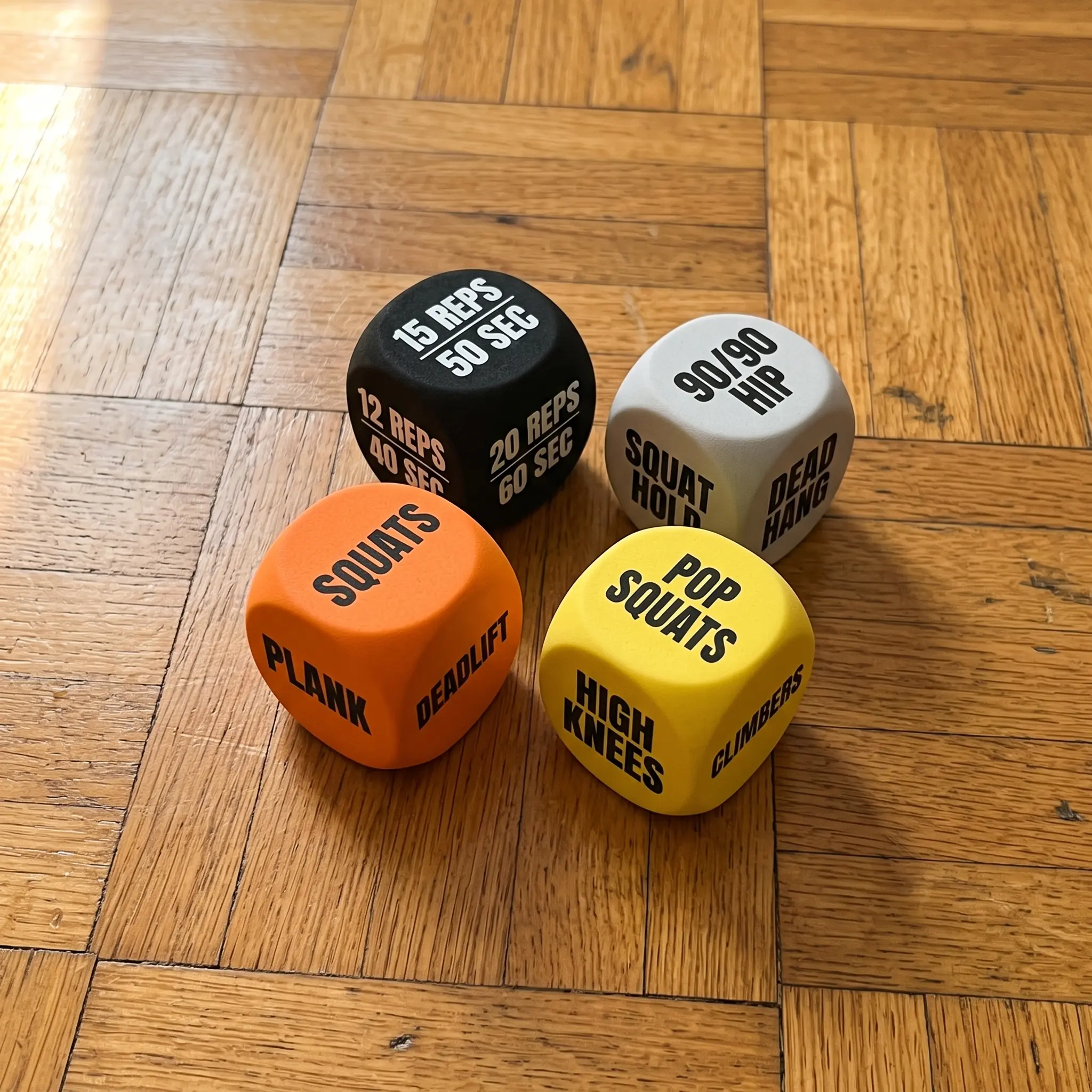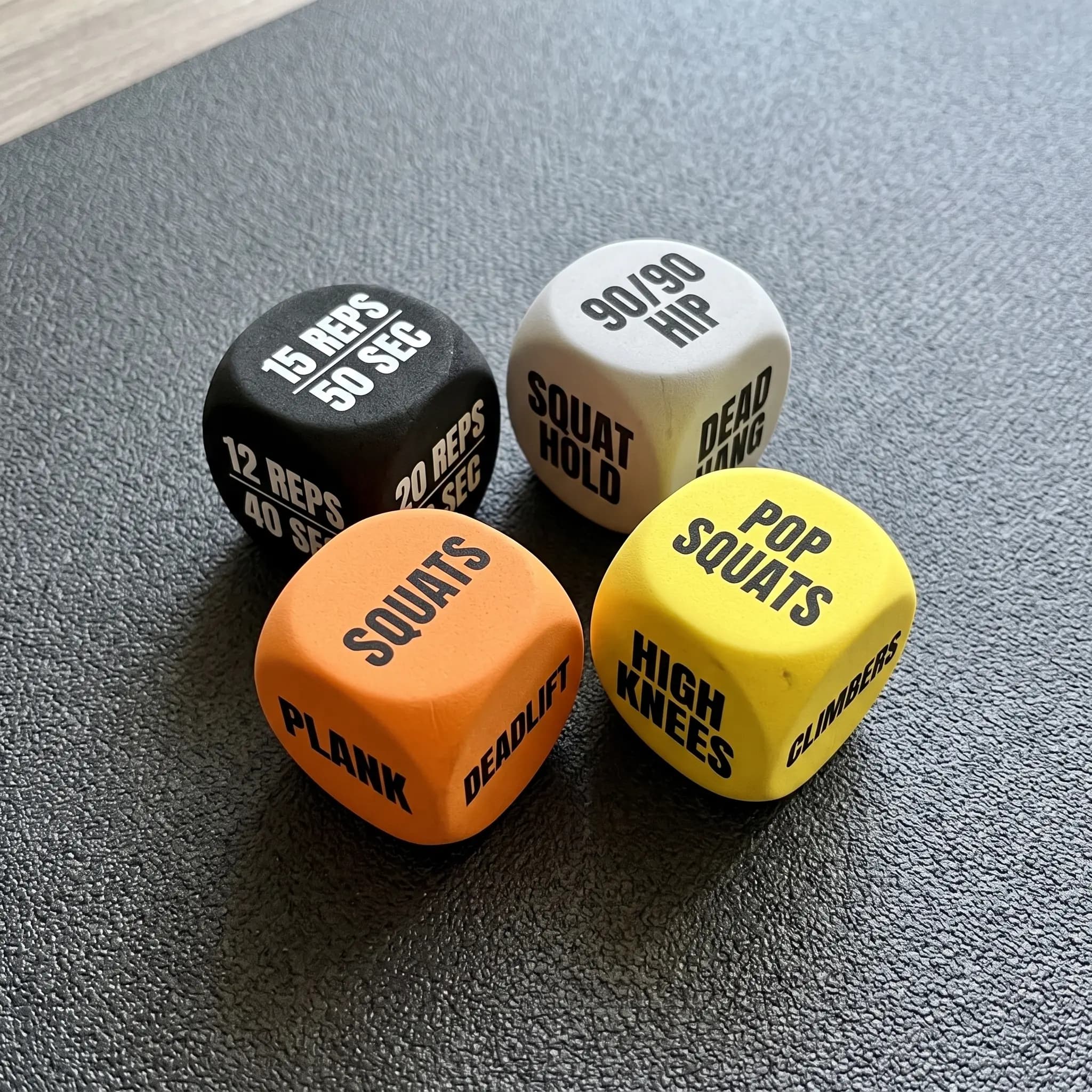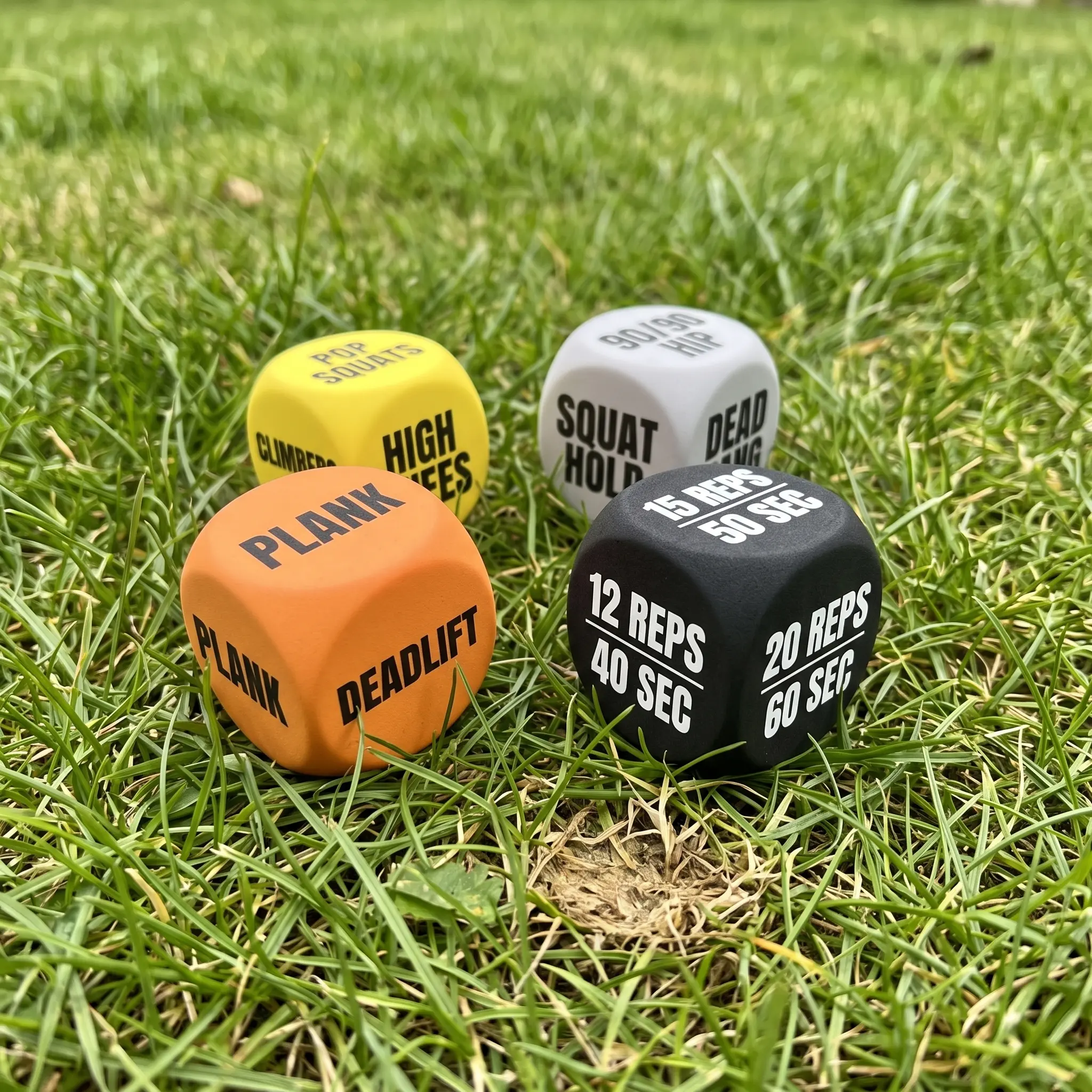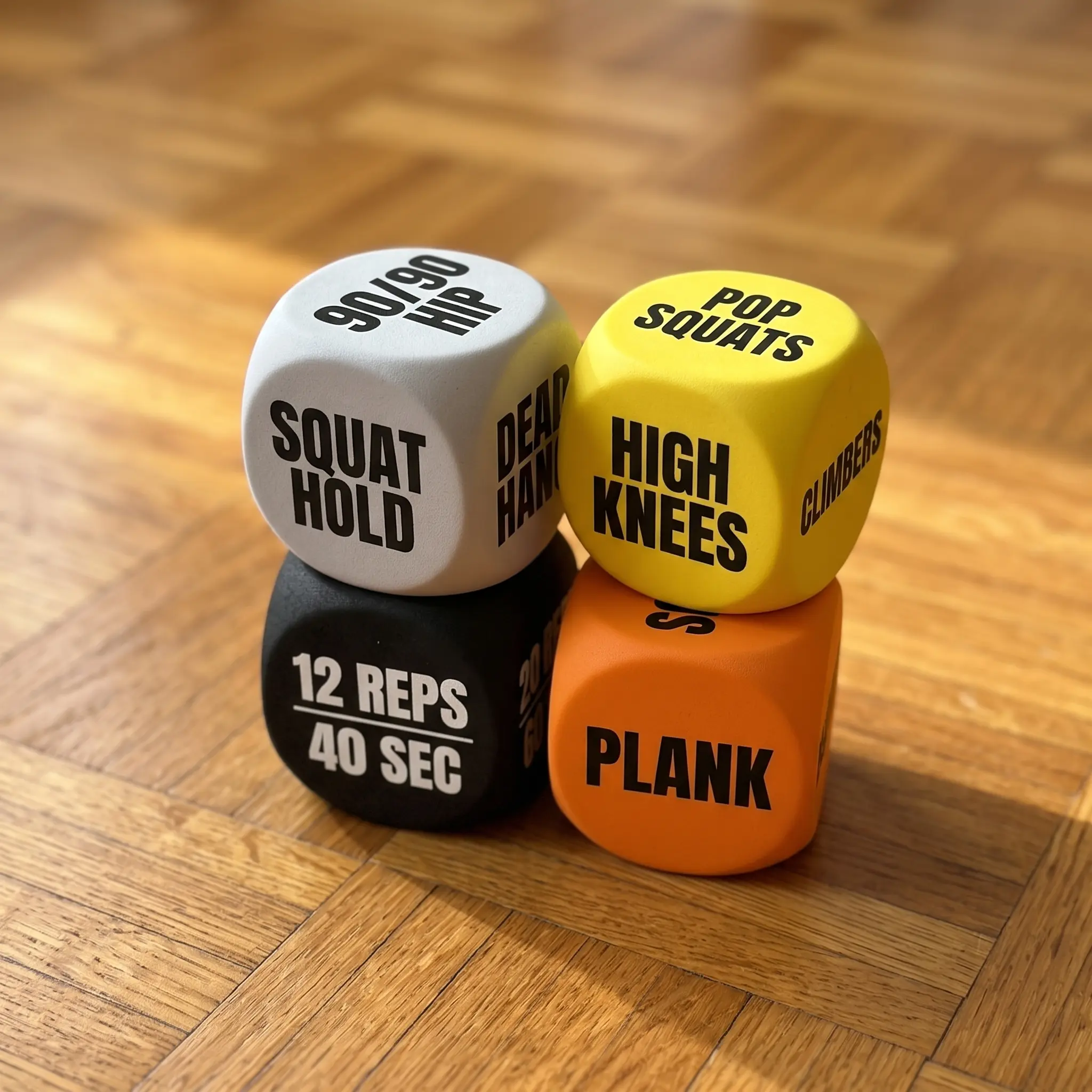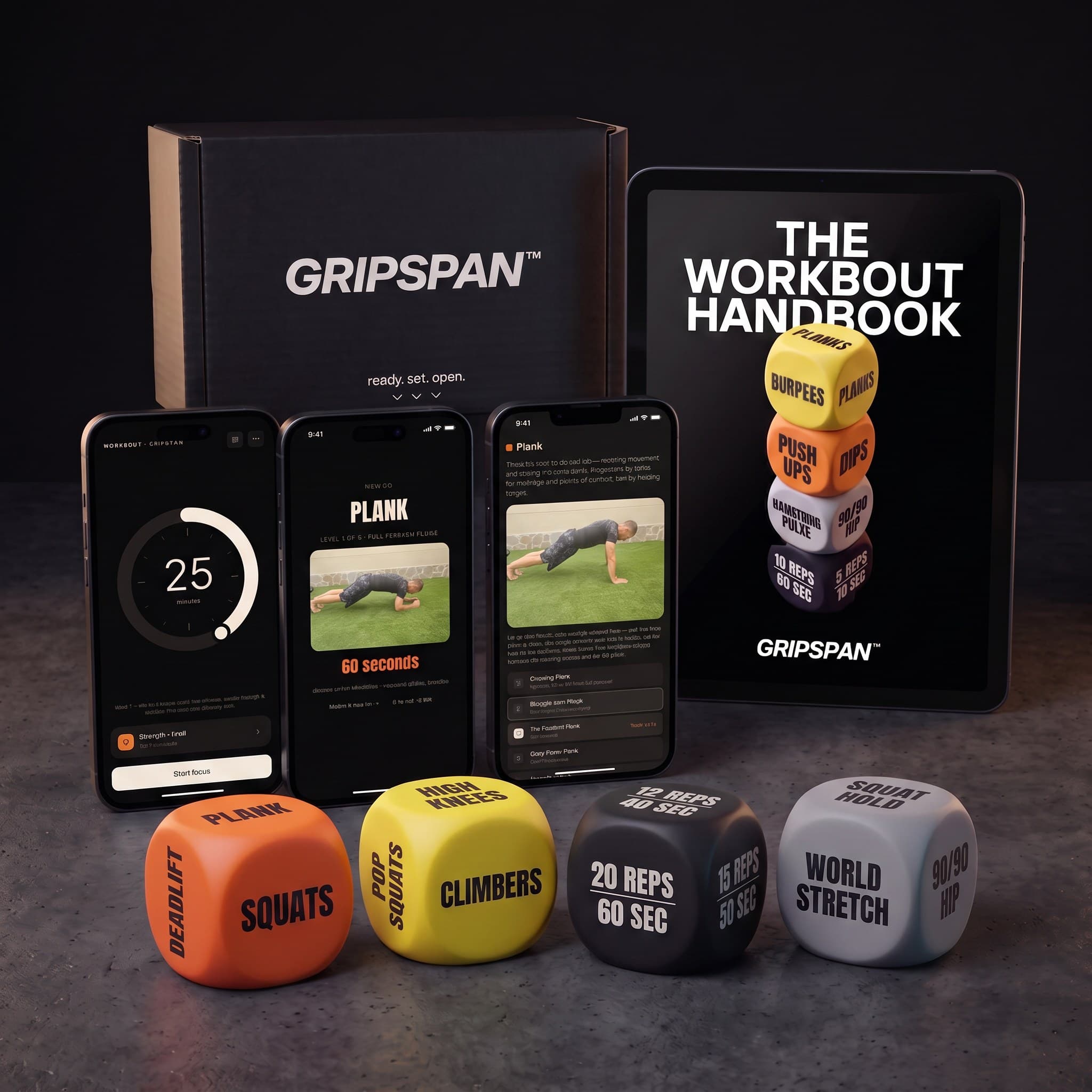
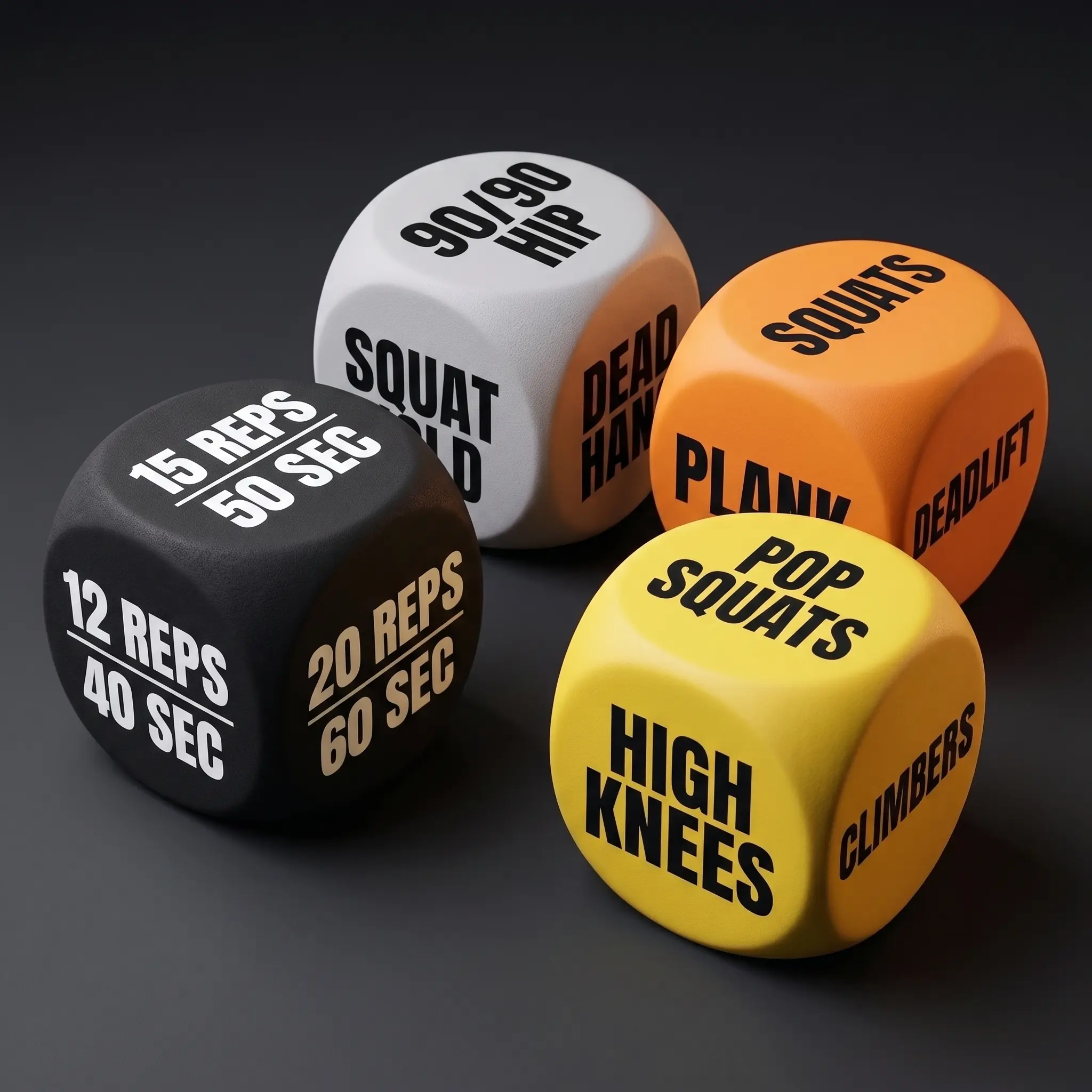
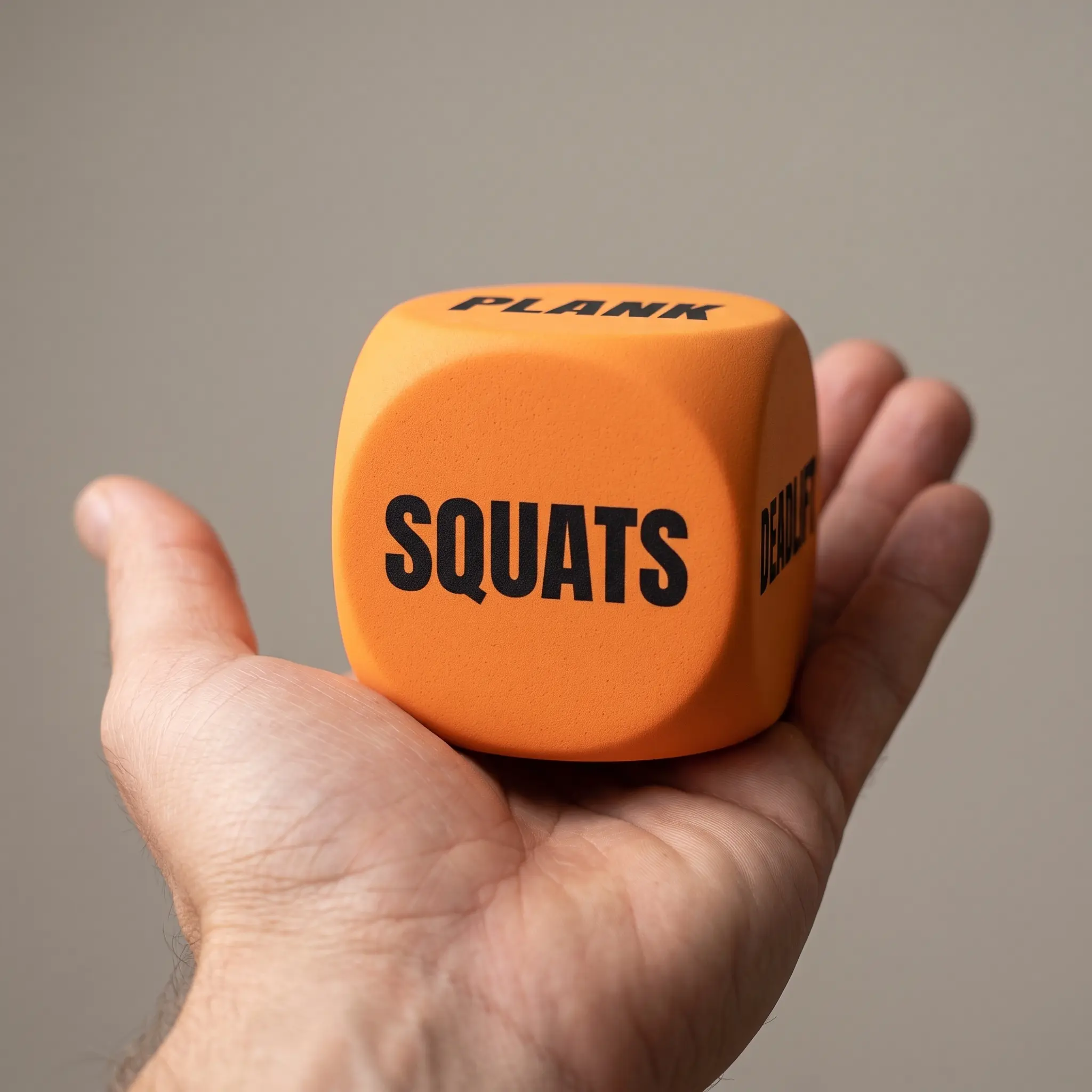
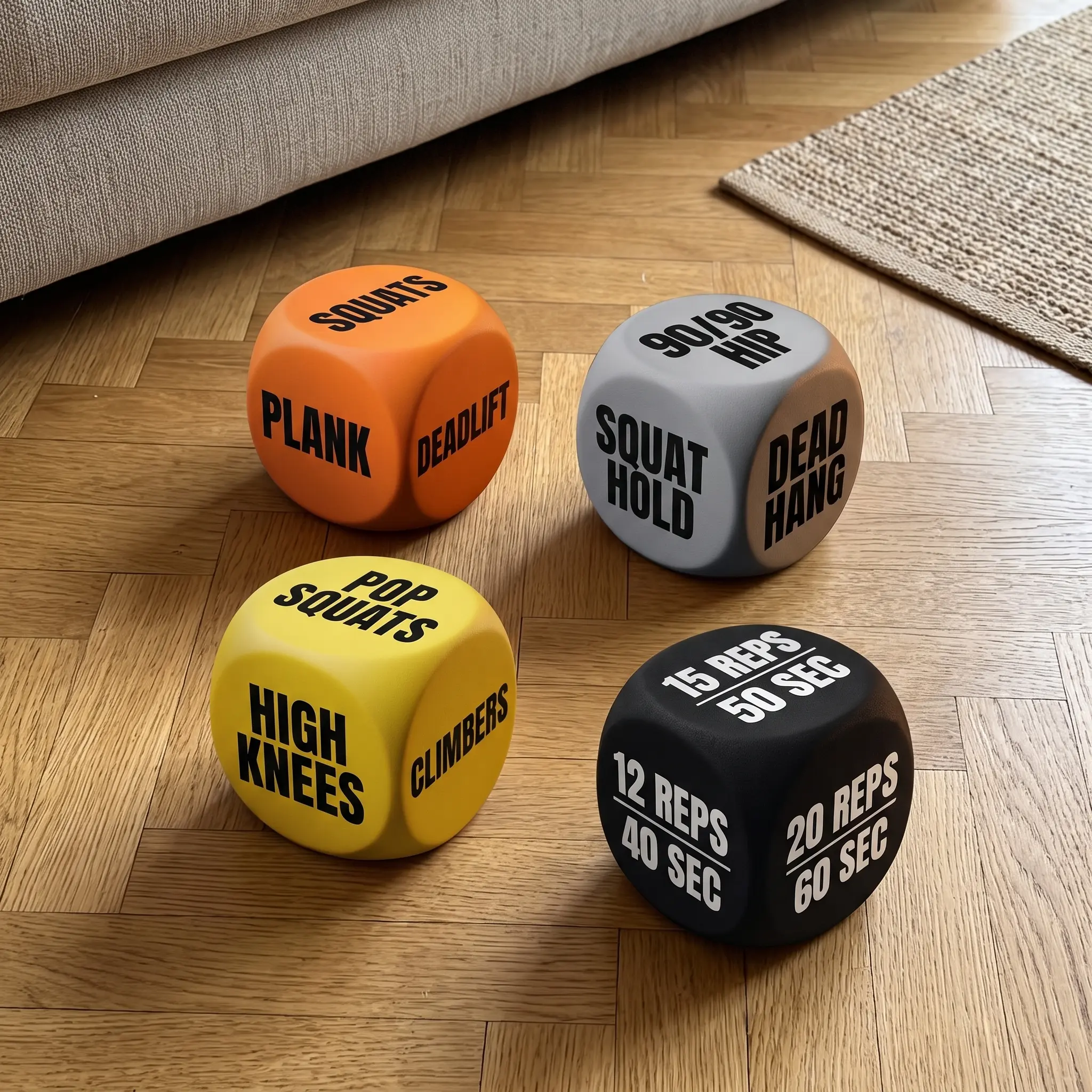
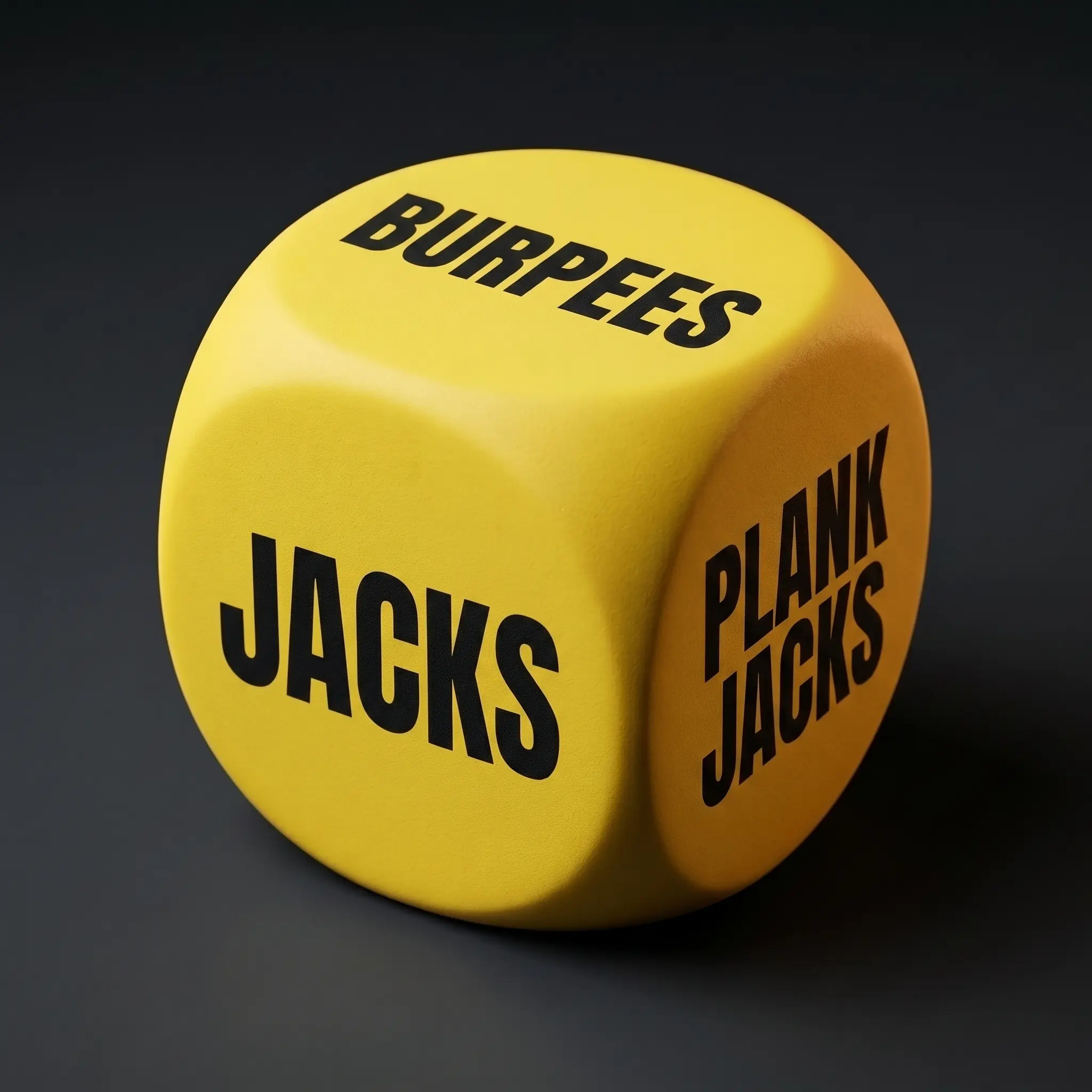
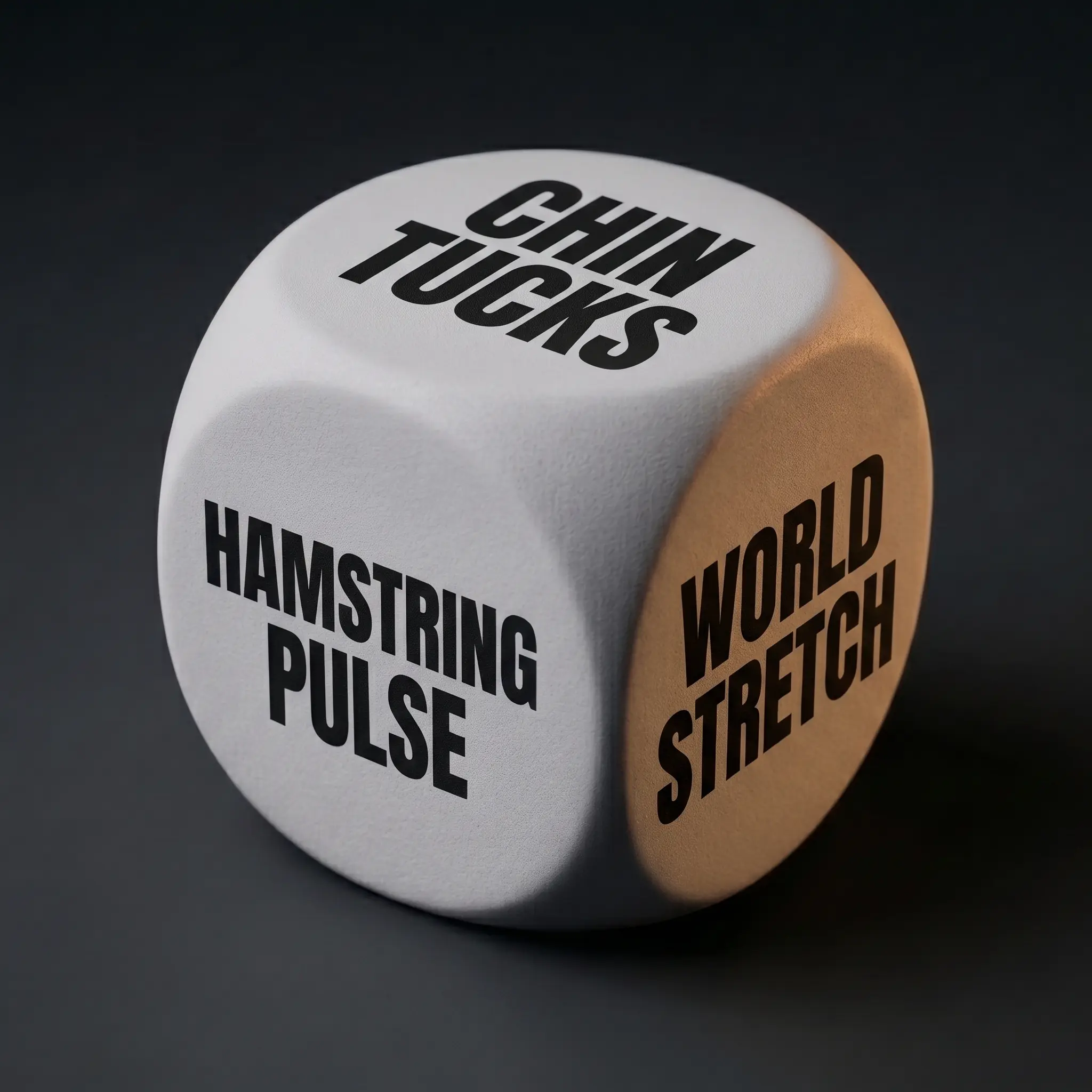
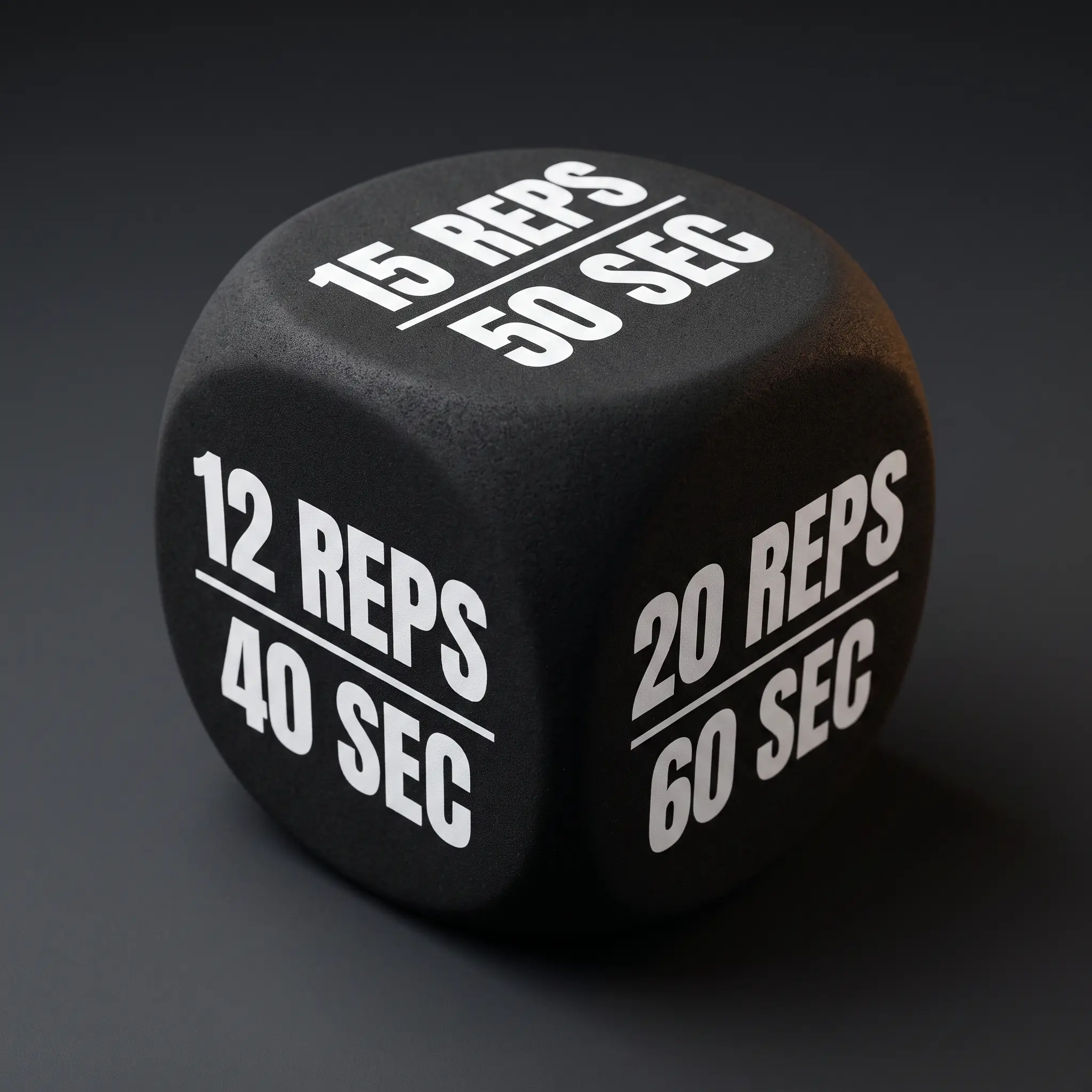
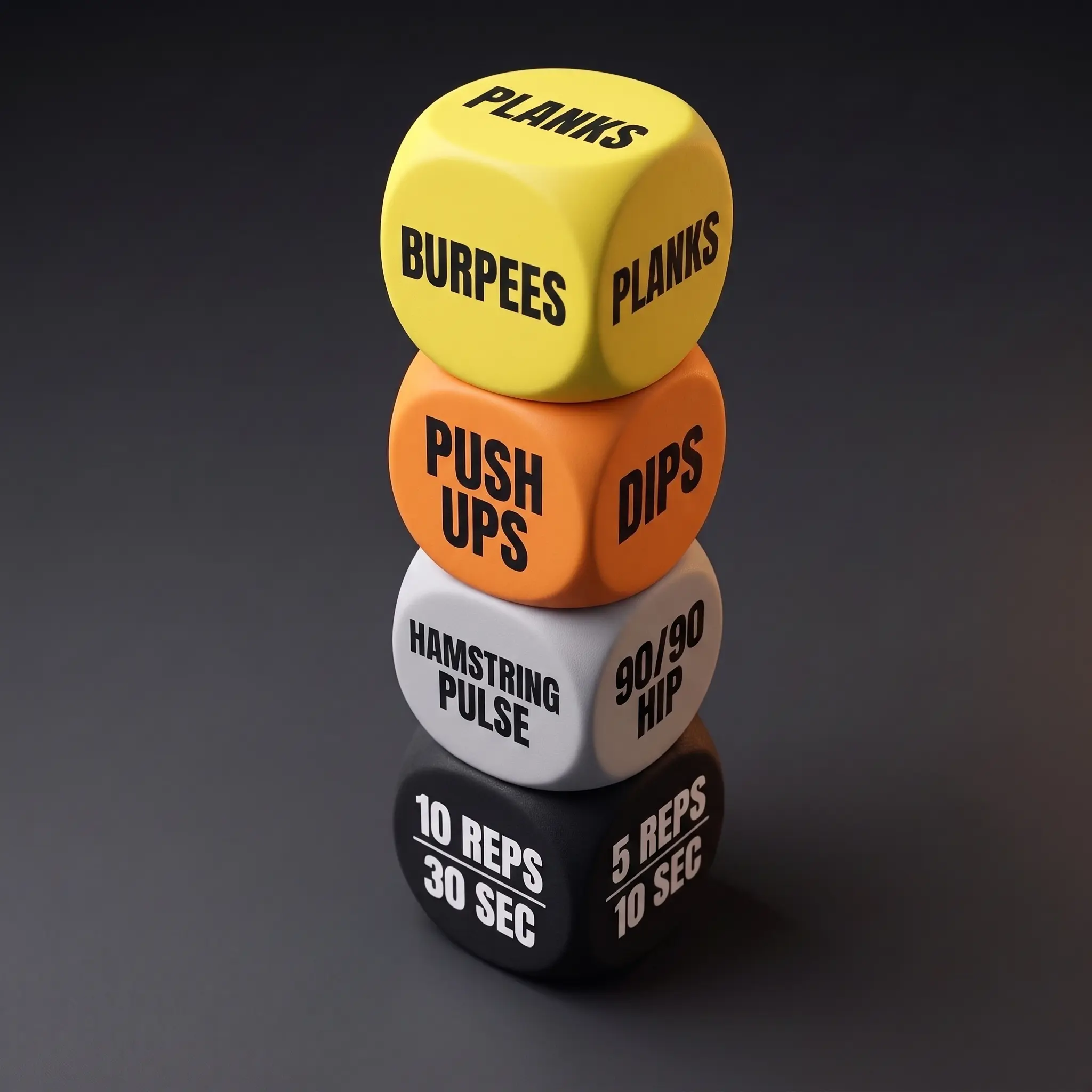
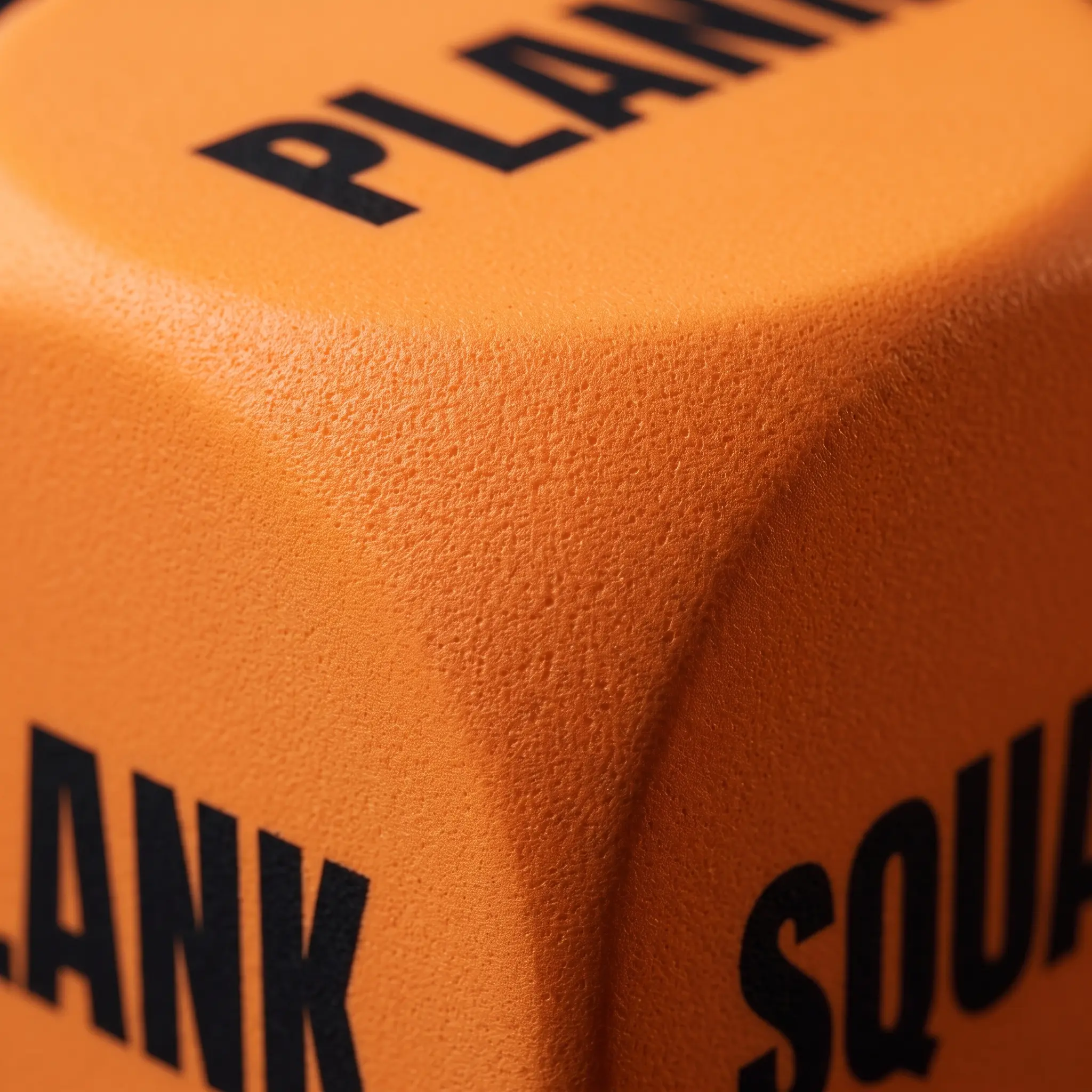
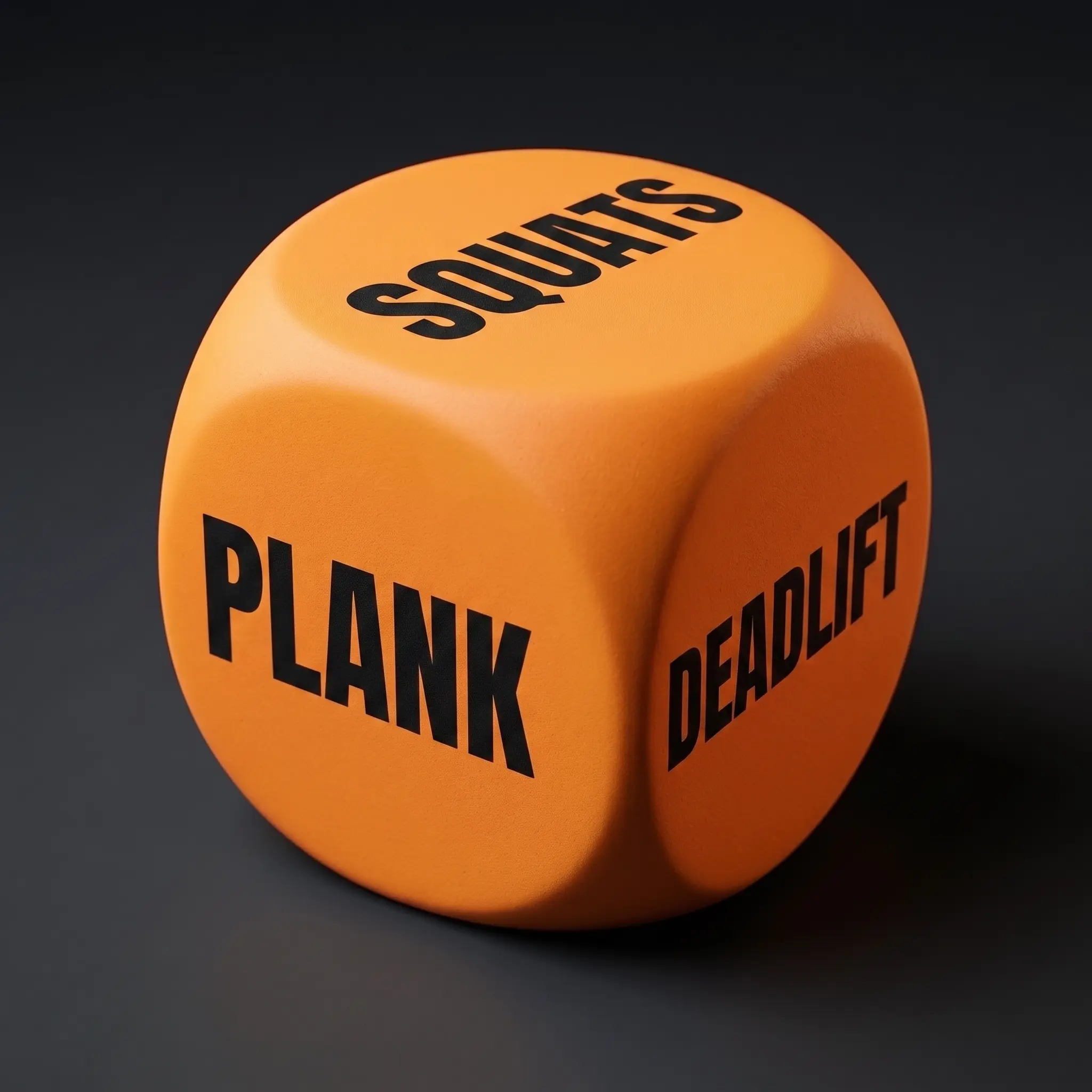
The WorkBout bundle: the four dice, the app on three phones, the Handbook on a tablet, and the Gripspan boxThe four WorkBout dice: strength, cardio, mobility and the time/reps dieThe orange Strength die resting in an open handThe four dice on a wooden floor next to a sofaThe orange Strength die showing Squats, Plank and DeadliftThe yellow Cardio die showing Burpees, Jacks and Plank JacksThe grey Mobility die showing Chin Tucks, Hamstring Pulse and World StretchThe black Time / Reps die showing rep counts and secondsThe four dice stacked in a towerClose-up of the Strength die's textured surface

Workbout Dice™

Strength, cardio and mobility scattered through your workday. Roll a die, do what it says, get back to work. Thirty to ninety seconds at a time.

Why this exists

You can trainfour days a weekand still sit too much.

Sitting time predicts mortality on its own, largely independent of how much you exercise. The workout and the stillness are two separate problems. Most people only solve one.

The word that matters is uninterrupted. Sit still for long stretches and the biggest muscles in your body switch off. The enzymes that clear fat and sugar from your blood wind down. Blood flow slows. Nothing dramatic happens in any single hour. Across a working life it adds up.

The problem isn’t sitting. It’s sitting without interruption.

So the fix is not more gym. It’s short movement, often, all day. Ten squats between two things you were going to do anyway. The research calls these exercise snacks. A minute of movement you’ll actually do beats an hour you won’t.

The orange Strength die resting in an open hand

Try it

Same chair.Different physiology.

Ten hours in a chair in unbroken blocks and ten hours broken up every half hour are two different days for your body. Drag the slider.

9:00a seated workday19:00
0

0 breaks. Ten hours of unbroken stillness. The leg muscles switch off, the enzymes that clear fat and sugar wind down, and the hours quietly stack.

The system

Four dice.Zero decisions.

The hard part of moving often isn’t the moving. It’s the deciding. Every decision is friction, and friction is where good intentions die. So you don’t choose. The die says squats, you do squats.

The randomness is the point. Left to choose, you’d drift toward the movements you like and away from the ones your body needs. Chance is a more impartial programmer than you are. And the randomness stops at the roll: what’s on the faces was chosen carefully, and behind each one sits a ladder of levels.

The four dice

Three tell you what.One tells you how much.

The orange Strength die

Die 01 · Strength

Compound bodyweight strength.

Squats, push-ups, lunges, plank, dips, the single-leg deadlift. The pushing, squatting, hinging and bracing patterns a body needs to stay capable.

Effort. Moderate to hard. You’ll feel these.

On the six faces

  • Push-ups
  • Plank
  • Lunges
  • SL Deadlift
  • Dips
  • Squats
The yellow Cardio die

Die 02 · Cardio

Heart rate, fast.

Burpees, climbers, jacks, plank jacks, pop squats, high knees. The die that gets you breathless on purpose, which is the effort the research is built on.

Effort. Vigorous.

On the six faces

  • Climbers
  • Plank Jacks
  • Burpees
  • High Knees
  • Jacks
  • Pop Squats
The grey Mobility die

Die 03 · Mobility

Undo the desk.

World’s greatest stretch, chin tucks, hamstring pulse, squat hold, 90/90 hip, dead hang. Tight hips, forward head, rounded shoulders, a compressed spine, worked on one face at a time.

Effort. Low. Quality of movement, not exhaustion.

On the six faces

  • Chin Tucks
  • Squat Hold
  • World Stretch
  • Dead Hang
  • Hamstring Pulse
  • 90/90 Hip
The black Time / Reps die

Die 04 · Time / Reps

The dose.

Doesn’t name a movement. It sets how much. Some faces are rep counts, others seconds. Read the one that fits what you rolled.

Effort. Calibrated so every bout lands at roughly 30 to 90 seconds.

On the six faces

  • 8 reps / 20 sec
  • 12 reps / 40 sec
  • 5 reps / 10 sec
  • 20 reps / 60 sec
  • 10 reps / 30 sec
  • 15 reps / 50 sec

The app

One full work cycle,compressed to seconds.

The dice work on their own. Roll, read, move, no screen required. The app adds the two things plastic can’t: structure, and your level on every movement. This is what Work Mode does around you all day, with the timers compressed.

WorkBout · GripSpanDemo · time compressed

tap the dial to change. In the app you drag it.

All sets · 1 rolltap to configure
  1. 1

    Set the interval

    Deep work might want 50 minutes. Admin, 15. The dial is yours. The 25/5 numbers are a default, not a law.

  2. 2

    Focus

    One task, full attention. The countdown removes the “when should I stop” negotiation.

  3. 3

    The interval ends. Roll.

    A long alarm, then the roll. The die picks the movement, the black die picks the dose, your saved level picks the version.

  4. 4

    Move, 30 to 90 seconds

    The non-negotiable half of the break. It clears the fog, restores blood flow, and pays the day’s movement debt.

  5. 5

    Rest, for real

    If you have another minute: look far away, breathe slowly, step outside. The app suggests one each break. The firm rule: don’t scroll.

  6. 6

    Back in, sharper

    One tap starts the next interval and the cycle carries itself. Six-ish breaks on a normal workday, a few vigorous ones among them.

Also in the app

Three modes. One job: stay out of the way.

  • Levels. It knows your rung on every ladder and serves the right version of what you roll.
  • Quiet mode. Shared office, thin floors. Only silent, low-impact rungs.
  • Free mode. No timer, no structure. Just the dice.

Included with every order

The WorkBout Handbook

Every movement, every rung, demonstrated on video. The science behind the system, in full. Interactive, in your browser. Not a PDF. This page is the short version. The handbook is the whole thing.

Every face is a ladder

The hardest versionyou can do well.

Squats on the die means chair squats for one person and pistol squats for another. Every one of the 18 movements has a ladder of levels, 83 in total, from a version anyone can do to one most people never will. You find your rung on each movement. Here is how.

Do a set at a rung, then answer

  1. Could you keep good form for the whole set?

    Straight lines stayed straight, range stayed full, nothing collapsed at the end.

  2. Did it feel like honest work?

    Or was it trivially easy?

  3. Any joint or sharp pain?

    Pain, not muscle effort. Burn is fine. Sharp is not.


Two of the eighteen ladders

Squats7 rungs

  1. 1Chair Squat
  2. 2Bodyweight Squatthe standard
  3. 3B-Stance Squat
  4. 4Deep Squat
  5. 5Pistol to Chair
  6. 6Pistol Squat
  7. 7Pistol Floor Sit-Up

Push-ups5 rungs

  1. 1Incline Push-Up
  2. 2Kneeling Push-Up
  3. 3Full Push-Upthe standard
  4. 4Decline Push-Up
  5. 5Archer Push-Up

Climb when a level stops being honest work. Drop a rung on a rough day. The person who does the desk push-up on a bad day keeps the habit. The one who insists on full or nothing does nothing.

What it does

It pays off in twenty years.And this afternoon.

  • Blood sugar

    Your muscles clear the meal

    A few squats after lunch ask your largest muscles to pull sugar out of the blood directly. Breaking up sitting blunts post-meal glucose spikes better than one longer walk.

  • Focus

    The next block is sharper

    A short movement break reliably improves concentration in the work that follows. Your attention runs in roughly 90-minute waves anyway. The break lands in the trough.

  • Heart

    Vigorous minutes count

    In a 2022 study in Nature Medicine, adults who did no formal exercise but accumulated a few vigorous one-to-two-minute bursts a day had substantially lower mortality. That is what the Cardio die is for.

  • Strength

    Less volume than you think

    In one trial, two one-minute bodyweight snacks a day for four weeks improved sit-to-stand scores by 31%. No gym, no equipment.

  • Balance

    A skill that decays unused

    In a 2022 study, people who couldn’t hold a 10-second one-legged stance had roughly double the risk of dying over the next decade. Single-leg movements keep the whole system awake.

  • Floor

    The position chairs took from you

    How easily you get down to the floor and back up predicts survival. The deep squat is the position most of humanity still rests in. You get it back by visiting it.

None of these is a fitness vanity metric. They are ordinary abilities you either keep using or quietly lose. The dice are a way of asking for all of them, a little at a time, for years.

Where it fits

Home office. Open office.Hotel room. Park.

  • The four dice on a parquet floor

    The home office

    The environment it was designed around. Dice on the desk, app on the home screen, floor space for the full range.

  • The grey Mobility die

    The shared office

    Chin tucks are undetectable. A hamstring pulse reads as stretching. Desk push-ups are nearly invisible. Quiet mode serves only the silent rungs.

  • The four dice on a training mat

    Travel

    The dice weigh nothing and need no space. Thin hotel floors mean the silent variations. If you keep rolling on the road, the habit is yours.

  • The four dice on grass

    Family and weekends

    Free mode plus real dice turns it into a game. Kids love rolling and doing silly movements. You’re modelling the relationship with movement you’d want them to have.

Your first month

Week one is aboutshowing up.

  1. Week 1

    Calibrate

    Four breaks a day. Mostly the Mobility and Strength dice. Find your rung on each movement. Measure nothing except whether you showed up. Most people notice something by Thursday: the afternoons feel clearer.

  2. Weeks 2–4

    Consolidate

    Six to eight breaks. Bring in the Cardio die. Three honest breathless bouts a day is already in the range the research found meaningful. By week four the roll is a reflex, not a decision.

  3. Month 2+

    Climb

    When a level stops being honest work for several sessions, try the next rung. Each climb is a real, visible strength gain. No schedule, no rush.

Where you keep the dice decides whether you use them. If you can’t see them, they don’t exist. Dice in a drawer are dice you’ll forget by Wednesday. Dice next to your keyboard get rolled several times a day without thinking.

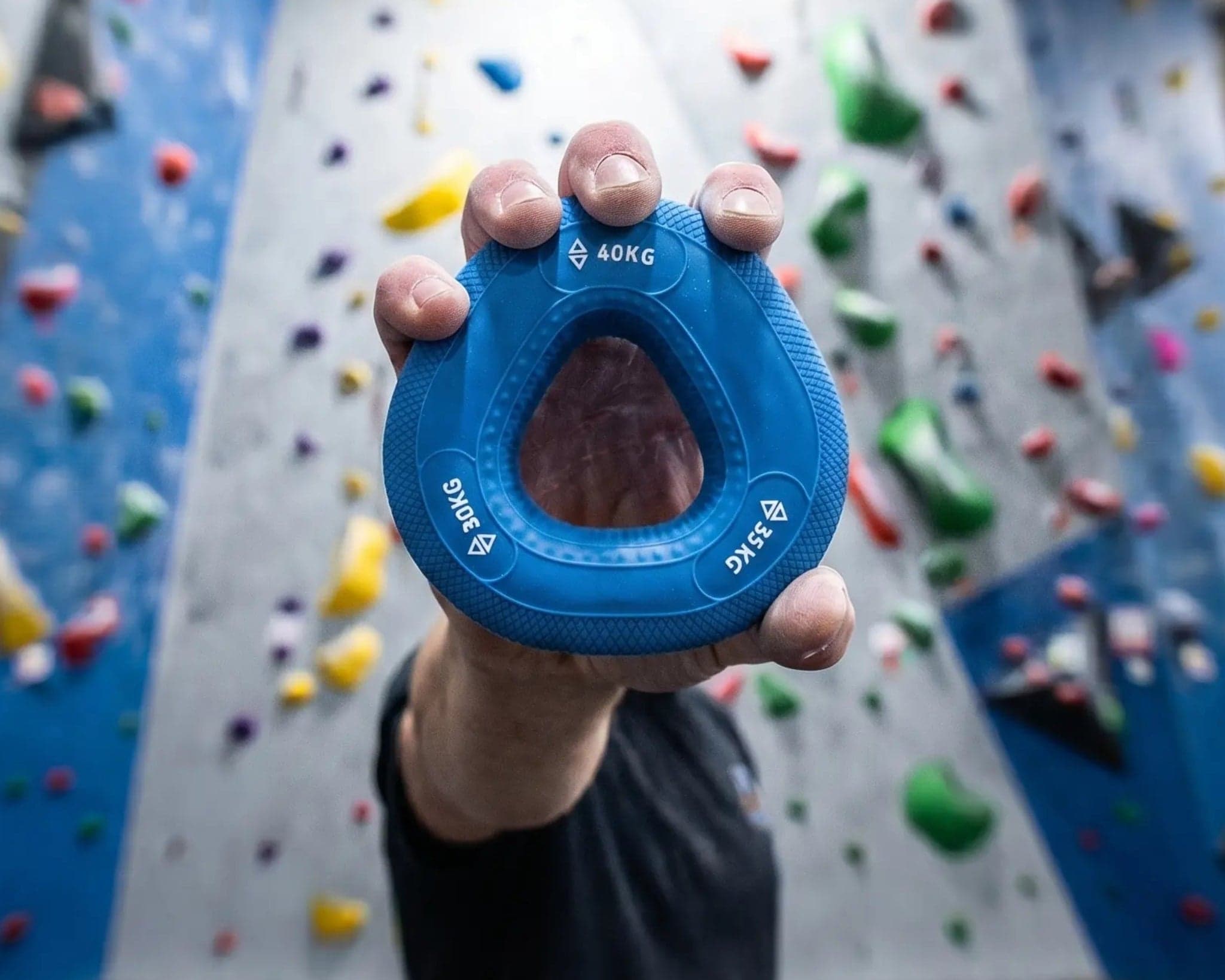
The Gripspan system

Dad Hands did it for your hands.This does it for the rest of you.

Same idea. A small stimulus, many times a day, woven into hours you already live. Dad Hands keeps a grip ring in your hand all day. The dice get the rest of you up from the chair.

The four WorkBout dice

Movement breaks

WorkBout Dice™

Four dice, 18 movements, 83 levels. Strength, cardio and mobility, scattered through the workday.

  • Breaks up the sitting a workout doesn’t cancel
  • 30 to 90 seconds at a time, no equipment
  • Fits a home office, a shared one, or a hotel room
Add to cart
Dad Hands grip ring in use

Grip training

Dad Hands™

High-frequency grip training. Builds neural efficiency, muscle density and tendon integrity, the internal architecture of a hand that works.

  • Neural adaptation, more motor units recruited
  • Muscle and tendon density over time
  • Grip strength that compounds daily
Get Dad Hands
The four dice stacked on a parquet floor

WorkBout Dice™ by GripSpan

Your body keepswhat you ask of it.This is how you ask.

Ten squats here, a hang there, several times a day, inside hours you already live. No gym bag, no hour to find, no willpower burned. A year in, the dice are just part of your desk and the breaks are just how you work.

  • Four dice. 18 movements, 83 levels.
  • The WorkBout app
  • The WorkBout Handbook
  • 99-day money-back guarantee
Get the dice

99-day refundSecure checkoutFree shipping

WorkBout Dice™ by GripSpan

Questions.

Everything you need to know about the dice, the app, and what to expect.